The situation is delicate as the cost of imported notebooks at 0% GST works out cheaper than Indian notebooks: Request for immediate remedial measure to the Govt.
The Indian notebook manufacturing sector faces imminent collapse, with grave consequences for lakhs of employment, investment, and self-reliance.


Bengaluru – The All India Notebook Manufacturers Association expresses its deep gratitude to the Prime Minister and the Government of India for the bold steps taken under the GST 2.0 reforms, aimed at simplifying taxation and supporting economic growth.
However, the situation that has arisen with imposing of 0% GST on notebooks with 0% custom duty as per Asean Free Trade Agreement, will play havoc with Indian Notebook manufacturers & industry.
Under the ASEAN Free Trade Agreement, imports from countries like Indonesia, Thailand, and Malaysia come in at zero customs duty.
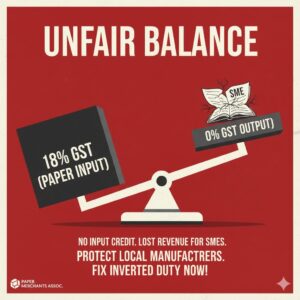
Now, with 0% GST, there is 0% IGST on imports, (which means that there will be no countervailing duty also on imported notebooks), making them totally duty free, cheaper than Indian products, despite India having sufficient capacity to meet domestic demand.
The recent decision to reduce the GST rate on paper used for notebooks to 0% was intended to ease costs in the education sector. Yet, in practice, this measure has unintended consequences.
Paperboard and other raw materials required for notebook manufacturing in India including packaging materials, gum, wires, packaging films etc attract 18% GST, which is being passed on to Indian notebook manufactures, who has no avenues to obtain input tax credit in order to make their products competitive against imports. Also, all paper boards consumed in the notebook industry are coated and the GST rate for the same has gone up from 12% to 18%, again increasing the cost for indigenous manufacturers.
Notebook manufacturing in India is primarily a small-scale, labour-intensive industry that sustains lakhs of workers in rural and semi-urban areas. The 0% GST is not conducive of “Made in India” initiative of our Prime Minister and his dream for promoting & using Swadeshi Products.
The surge of cheaper imports from Indonesia, world’s largest paper and paper products manufacturer, will wipe out local industries, causing massive unemployment and shutting down existing investments, detrimental to the Indian trade, foreign exchange and the country.
Hence, the Association wishes to draw urgent attention of Govt. of India to save domestic notebook making industry and its dire consequences
Key Challenges for the Industry
Rising Notebook Prices – Instead of decreasing, notebook prices are climbing, defeating the purpose of the GST reduction. Paperboard and other raw materials used in notebook production continue to attract 18% GST, with no input credit available.
Pressure on MSMEs – Higher raw material costs are eroding margins, pushing small manufacturers into financial distress and threatening their long-term sustainability.
Threat from Imports – Cheaper notebooks and paper imports are becoming more attractive, posing an existential risk to domestic manufacturers.
Unfair Tax Burden – While domestic producers struggle under GST on inputs, imported notebooks now attract 0% IGST, granting foreign manufacturers an undue advantage and undermining the “Made in India” initiative of our Prime Minister and his dream for promoting & using Swadeshi Products.
Predatory Imports from ASEAN Countries – Under the ASEAN Free Trade Agreement, imports from Indonesia, Thailand, and Malaysia arrive duty-free. Coupled with GST exemptions, imported notebooks are significantly cheaper than Indian products, despite India’s adequate domestic capacity.
Impact on Small-Scale Industry & Employment – Notebook manufacturing is largely a small-scale, labour-intensive industry, sustaining lakhs of workers in rural and semi-urban regions. If cheaper imports flood the market, the results will be widespread unemployment, closures of existing units, and loss of investments.